
Release stages
Together we assign the user stories to release stages. You see which features are available when.
For us, agile development doesn’t mean ‘everything is flexible’. It means clear priorities, small steps, software you can check at any time and quality assurance from day one.
The illustration shows a cycle: four stations sit on a ring, the starting station is highlighted, and dots move continuously around the circle.
Before implementation starts, we break your project down into manageable pieces. The story map shows all the features of your platform, organised by user journey and prioritised by business value.
Together we assign the user stories to release stages. You see which features are available when.

We work through the map. We clarify new insights and priorities together.

Everyone involved works with the same picture of the product.
Every task follows the same path, and at the end there is working software that you can test yourself.
Based on the priorities, we choose the stories that are needed next. We estimate the effort, get your approval and assign them to the team as soon as capacity is free.
The development team implements the stories in small steps and finishes what it has started before starting something new. Internal check-ins make sure blockers are spotted early. Code reviews safeguard quality at code level.
We check every finished feature internally and make it available to you on a preview link. You try it out yourself and approve it, or we make improvements.
Once a month we show what is finished, reflect internally on what we can improve and set the goals for the next month. This way we also improve our collaboration over the course of the project.
Quality assurance is part of every implementation step, every commit and every code review.
Every code change is checked by a second person from the development team: architecture, security, maintainability. No code reaches the main branch unchecked.
Automated tests in the stack for every pull request, tests of your platform for its own features, plus checks by people. Each level only tests what it changes itself, so a regression shows up where it originates.
The UX team checks new components against the approved design: spacing, colours, interaction patterns. Consistency is a must, not a nice-to-have.
Known security vulnerabilities in libraries are flagged by automated audits. Encryption, access rights and loading times are part of the checks before go-live.
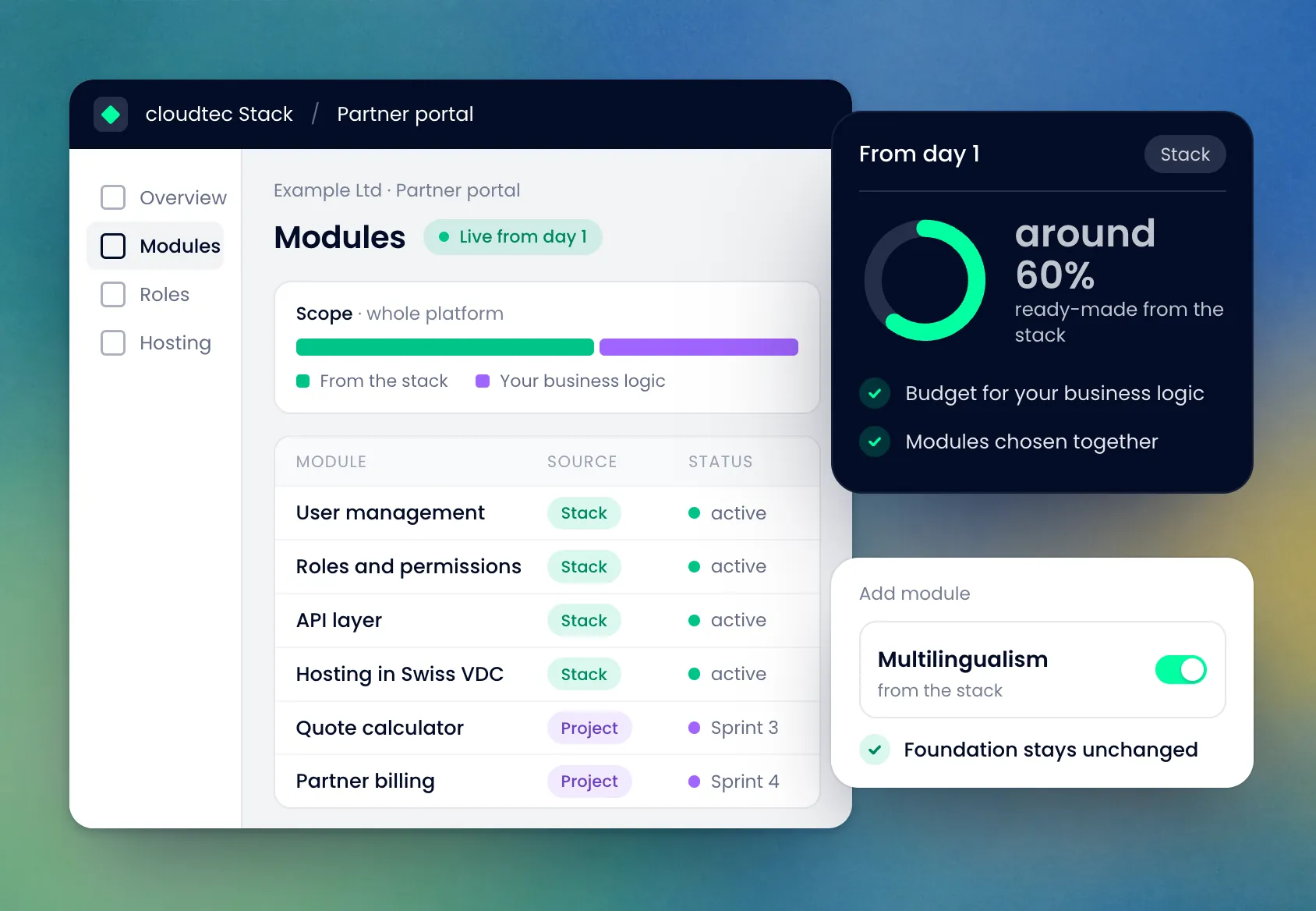
Our development is based on the cloudtec Stack: Symfony, API Platform, Docker and CI/CD pipelines. Around 60% of a typical platform comes ready-made from the stack from day 1: user management, API layer, roles and permissions, hosting in the Swiss VDC.
Your budget therefore goes into the business logic that only your platform needs.
Software you can check at any time: that’s how we work, and we’re happy to show you in detail.