The cloudtec advantage: technology we master ourselves
Over the years, we have kept developing our stack. It is built entirely on open source and adds our own framework of components, services, libraries and modules. It is the foundation of every project.
The illustration shows the stack as a pyramid of five layers with 33 building blocks, with the broad, highlighted foundation at the bottom. Above it float five new candidates whose paths converge at a checkpoint. Only one building block gets through and is added to the top layer.
30Technologies in the stack
Since 2013Symfony, stack in its third generation
4Technology layers
ISO 27001Certified operations
Principles
A stack that grows with every project
Every component in the stack meets three criteria: proven production readiness, long-term support and clean integration with the rest of the stack.
Open source first
The stack is built entirely on open source that we master and bring together in the best possible way. On top sits our own framework of components, services, libraries and modules: a great many in-house features that are a fixed part of the stack.
One stack for all projects
We decide which features and modules are added. Every improvement from a project goes into the stack and is used in all projects. Your project benefits from continuous development.
Proven in practice
What is standard in the stack has been running in production platforms for years. Anything new goes through an internal evaluation and real-world use before it is added.
Nothing in the stack without a reason
From the framework to the firewall: every layer with the tools that have proven themselves in production with us, and with the reason they are in the stack.
Symfony
PHP framework as the foundation, in use at cloudtec since 2013. Modular bundle architecture, active community, long-term support releases.
PHP
The language behind Symfony and Sylius. PHP 8.3+ with typed properties, enums and fibers: type safety and speed on a par with modern languages.
Sylius
E-commerce framework based on Symfony. Headless architecture, flexible product models, connections to payment providers, automated tests.
Doctrine ORM
Object-relational mapper for type-safe database abstraction. Schema changes are versioned and run through migrations.
API Platform
REST APIs from a configuration. OpenAPI specification, pagination and serialisation are generated automatically: the standard for all interfaces in the stack.
Stack UI
Our own UI framework: templates, styles and scripts for every component, built in-house instead of with Bootstrap or Tailwind. Prototypes are created with AI directly in code, from the same components that later go live.
HTML
Semantic, valid markup as the foundation of every page: the basis for accessibility, SEO and AI discoverability.
CSS
Modern features directly on the platform: container queries, light-dark() and custom properties as the theming layer.
JavaScript
ES modules without framework lock-in. What the browser can do on its own, the browser does.
Sass
Preprocessor for Stack UI: tokens, mixins and components, compiled into lean CSS.
MariaDB
Relational database for structured data, compatible with MySQL. The standard persistence layer in the stack.
Apache Solr
Full-text and faceted search, multilingual, with stemming and synonym support. The standard for search and filters in the stack.
Elasticsearch
Search and analytics engine in existing platforms. Full-text search with fuzzy matching and aggregations across large volumes of data.
RabbitMQ
Message broker for asynchronous processing. Decouples long-running jobs (imports, exports, notifications) from the page request.
Matomo
Web analytics on our own servers. Visits and user journeys stay in Switzerland, with no data flowing to advertising platforms.
Docker
Containers for reproducible deployments. Every platform runs in isolation, in an identical environment from development to production.
Portainer
Container management with a web interface. Administration, monitoring and scaling of the Docker environment, centrally across all platforms.
Traefik
Reverse proxy and load balancer for containers. Routes, TLS certificates and redirects are taken over automatically from the container configuration.
NGINX
Reverse proxy and web server on the front line: SSL termination, load balancing and caching in front of the application containers.
OPNsense
Open-source firewall and web application firewall. Network segmentation, intrusion detection and VPN access to the infrastructure.
Alpine Linux
Minimal Linux as the base of all containers. Small attack surface, fast builds, regular security updates.
PHPUnit
Unit and integration tests run in the pipeline with every commit. Plus static analysis with PHPStan and a consistent code style via PHP-CS-Fixer.
Behat
Behaviour-driven testing: business logic is described in readable scenarios and played through in headless Chrome, automatically in the pipeline.
Percy
Visual regression tests: versions are compared pixel by pixel so that broken layouts are spotted before go-live.
BugBug
End-to-end tests with a low-code approach: flows are recorded in the browser and then run automatically. This way, tests can be extended without writing code.
Blackfire
Profiling of the PHP runtime. Finds bottlenecks, monitors regressions and delivers concrete optimisation suggestions.
Sentry
Error monitoring across all platforms. Exceptions from production land in the backlog as a ticket with a stack trace instead of getting lost in a log file.
Git
Version control with branches and code reviews: every change traceable, every line attributable.
Bitbucket
Code hosting and CI/CD pipelines: builds, tests and deployments run automatically with every merge.
Jira
Planning and tracking: every feature and every bug has a ticket, traceable from concept to release.
PhpStorm
The team’s IDE. Code inspections, debugger and test runner work directly on the code, with shared rules for code style.
Stack UI
The interface we build ourselves
Stack 3.0 comes with its own UI framework. The templates, styles and scripts of every component come from our own development, not from Bootstrap or Tailwind. The admin area and the public website use the same building blocks.
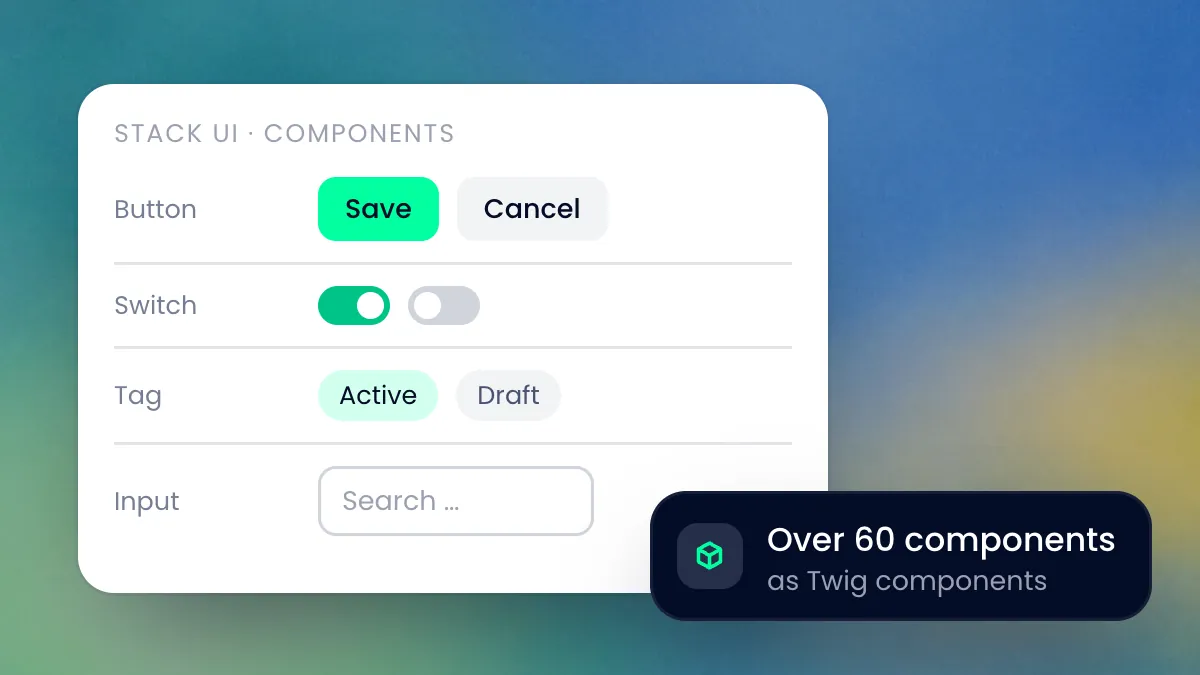
Over 60 components
From button and form to data table and dialogue to file upload. Every building block is a Twig component in Symfony. Its behaviour lives in a lean script that only loads when the page needs it.
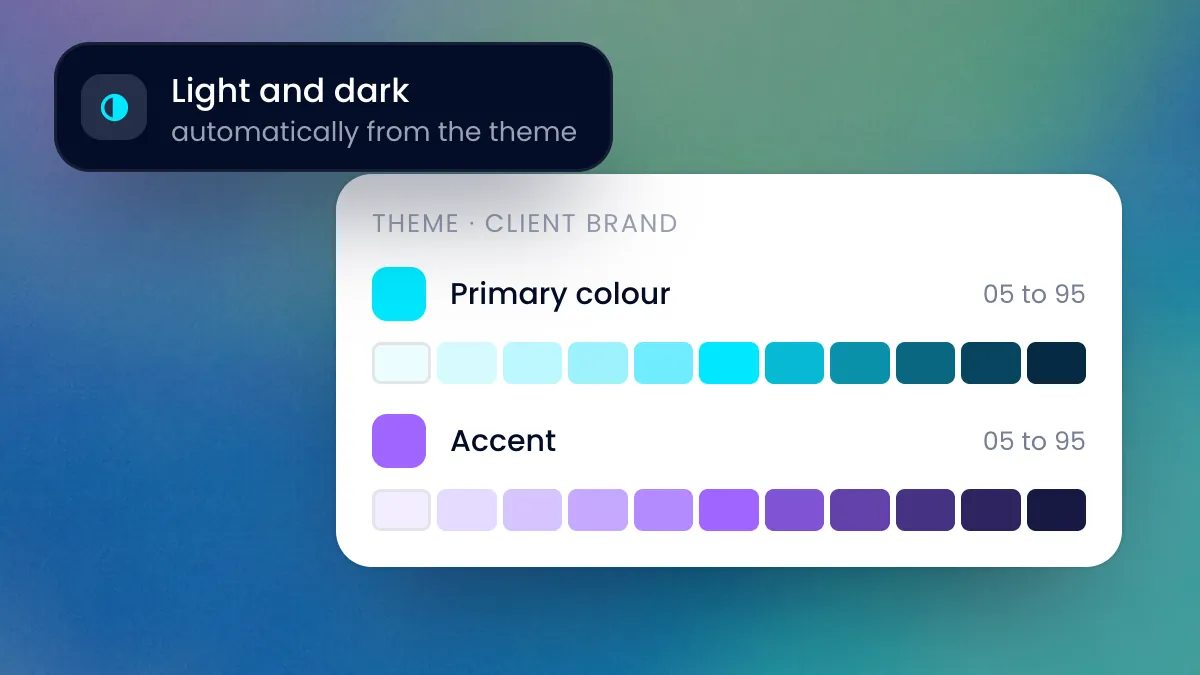
Your brand by configuration
Colours, fonts and logo come from a single theme file. Every base colour automatically produces a scale of eleven shades, light and dark mode included.
Accessible, including by keyboard
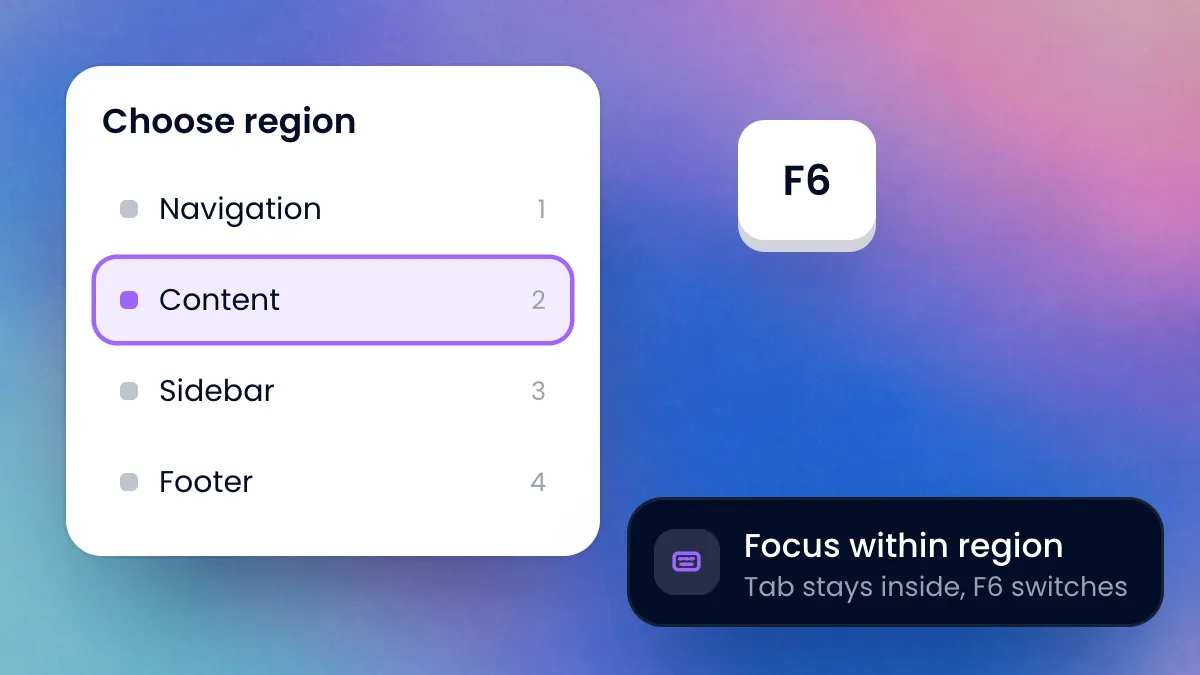
The interface is divided into regions that you jump between with F6. Dialogues keep the focus until they are closed, and animations step back when the operating system asks for reduced motion.
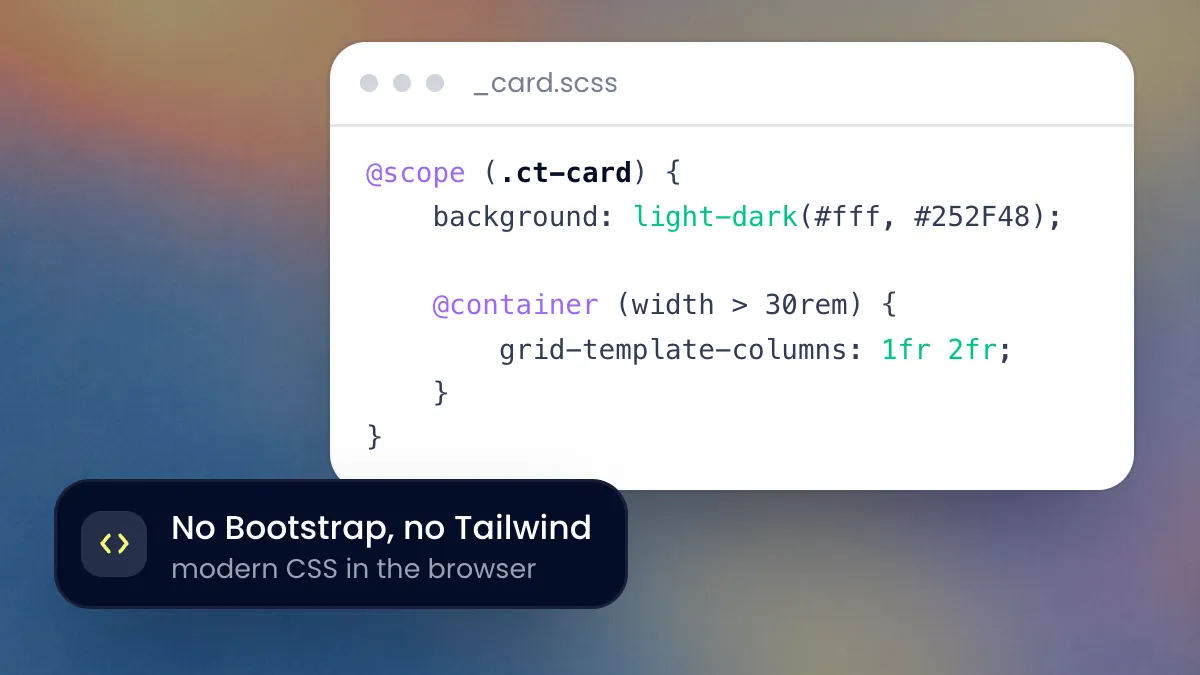
Modern CSS instead of dead weight
Container queries, @scope and light-dark() directly in the browser, without utility classes or unused framework parts. External libraries are only added where they solve a task better, such as Tiptap for the text editor.
Our own infrastructure
The cloud we run ourselves
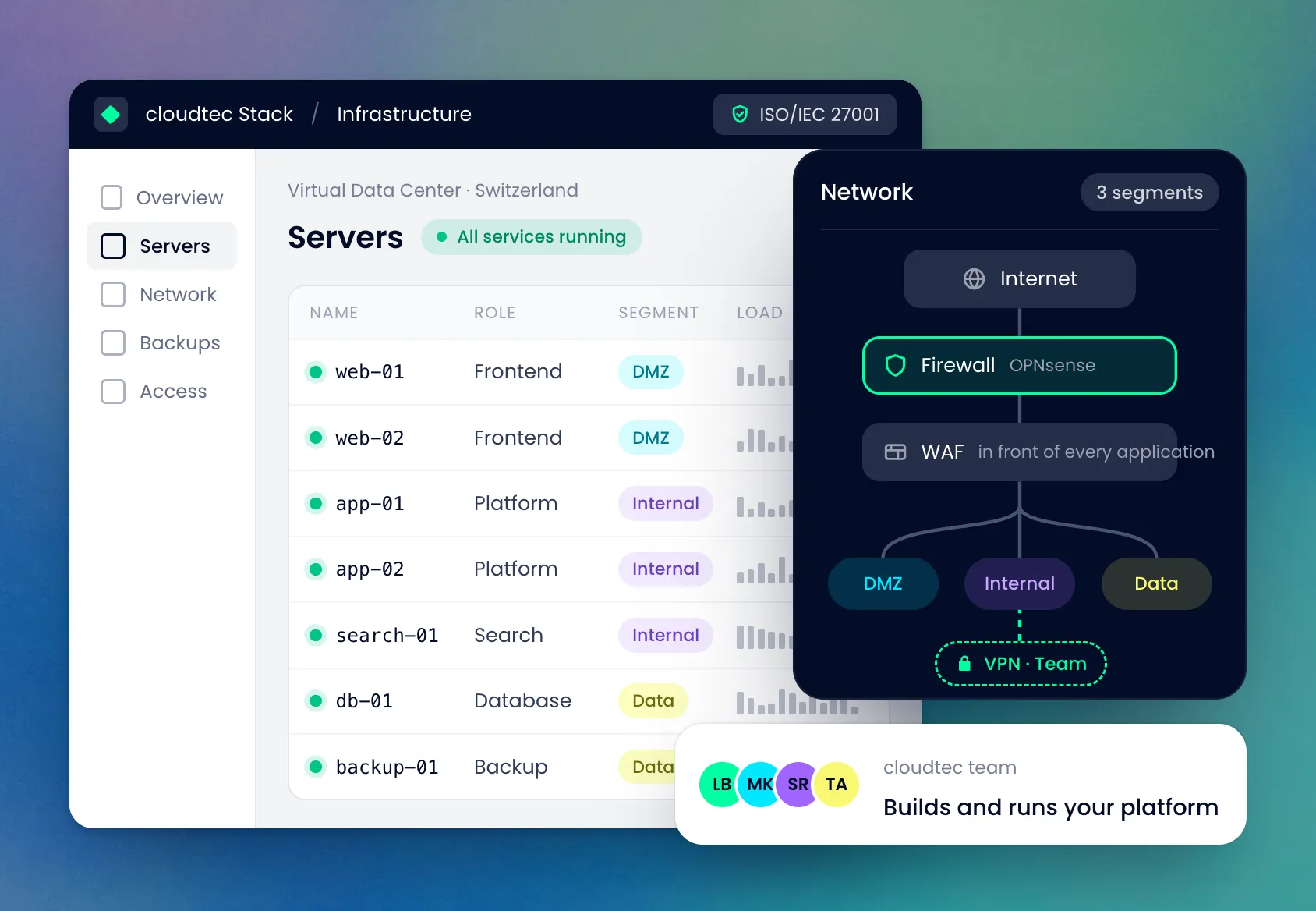
Most say ‘we host in the cloud’. We run it ourselves: our own virtual servers in hosttech’s Virtual Data Center in Switzerland, set up and operated by the same team that builds your platform.
Our own servers, not our own hardware: our virtual servers run in hosttech’s Virtual Data Center, ISO 27001 certified, at Swiss locations and not with a hyperscaler. We set up the network, storage and containers ourselves.
Our own network security: OPNsense firewall and WAF in front, network segmentation and VPN access behind.
Managed operations: development and operations are certified to ISO/IEC 27001, with documented and audited processes.
Short lines of communication: built and operated by the same team. When there is a fault, there is no chain of tickets across three providers.
Evolution
Three generations of the cloudtec Stack
Open-source components with long-term stability, hosting and data in Switzerland, and a foundation that grows stronger with every project.
1.0
2016: the origin
New projects no longer start from zero but on a shared base. The approach works, but each project evolves on its own copy. Improvements do not flow back into the base.
2.0
2019: one foundation, many platforms
We rebuild the stack as a monorepo, today with 23 packages. Every project uses them in a defined version, and one update brings an improvement to all platforms. Docker and automated deployments make operations consistent end to end.
3.0
2026: built for working with AI, in use from 2027
The third generation brings together what we have learned from two generations: our own UX library with standardised components, MCP as the basis for AI agents, more clearly decoupled layers and more security. On top of that, the stack is tuned for performance.
From the blog
From the engine room
How we build, test and operate. Posts from the development team.
Tech ·
A hundred applications later: looking back on the move
Data centre move completed. Three things we would do exactly the same way next time, and one we will approach differently.
What makes open-source solutions special, why they form the core of our stack and what that means for maintainability and for our clients’ independence.