A hundred applications later: looking back on the move
Announced in December, completed in March: our platforms now run in the hosttech Virtual Data Center. What worked, what was tight and what we will do exactly the same way again next time.
In December we announced the switch: around a hundred server instances from more than twenty clients, a new partner, one person per application. Now the last application has moved and the old environment has been switched off.
The process in figures
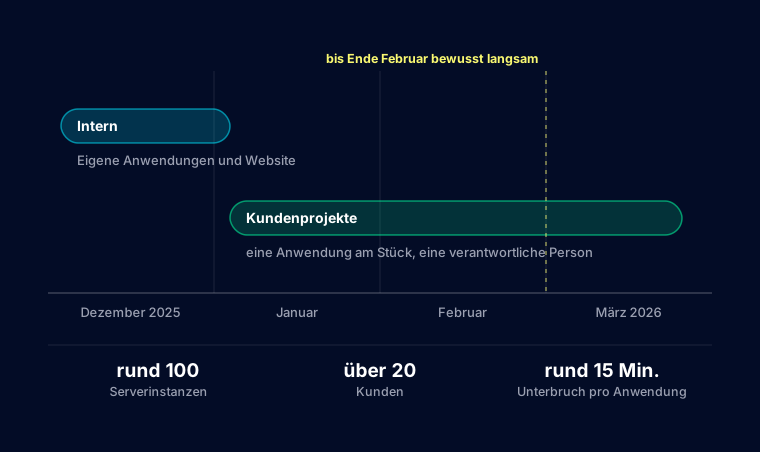
109 services on 110 server instances and around two terabytes of data, spread across the projects of more than twenty clients and our internal systems.
One epic per client, one story per server instance, a separate story for the backup of each project. That is what the plan looked like in Jira, and that is how it was worked through: first internal applications and our own website, then the client projects, deliberately slowly until the end of February. The interruption per application stayed at the announced 15 minutes or so.
What was tight
The IP change. Every interface that was set to our old address had to be adjusted: firewall rules at clients, IP restrictions on API keys, webhooks from the repository. Coordination with the clients’ IT needed more meetings than the migration itself. Next time, the interface inventory comes at the start, not in the week before the move.
The backups. A separate story per project sounds like bureaucracy. In return, it made sure that no directory was forgotten and that the old state was only switched off once the new one was backed up.
The certificates. Until the new certificate for a domain was issued, the domain ran with an imported interim certificate on the new firewall. Unspectacular, but without this step the domain would not have had a valid certificate in the meantime.
What remains
An inventory that is accurate, because we touched every instance individually. A clear separation: production environments run on our own virtual servers, non-production environments use the database and storage services of the Virtual Data Center. And a checklist that will apply again for the next move, with the interface inventory in first place.
‘Hundreds of applications, services and interfaces run there, in a growing environment with high quality standards, very active clients and a rising number of creative and motivated developers, and with fast technological change and the occasional outage and difficulty. What could possibly go wrong? In the end, the satisfaction of a job done outweighs everything.’
Marc Christen, Senior Cloud Engineer
What this means for the operation of your platform is on the Operations & cloud page.
 Written by
Adrian Arnold
Senior Project Manager