Writing Assistant
Better texts without switching tools: the Writing Assistant shortens, sharpens and translates directly in the editor, in your brand’s tone of voice.
Structured data, interfaces and fixed connection points. Your AI tools access them, and we use AI within the stack, from text suggestions to data normalisation.
The illustration shows the stack as three layers. The AI sits in the middle layer as a highlighted point; its paths reach into the content above and the data below, and connections lead outwards to three AI tools.
By now, every platform claims ‘AI integrated’. The difference lies in what it is used for, and what it is deliberately not used for.
Your own AI tool, for example Claude, ChatGPT or Copilot, runs outside the platform, whether a provider supplies it or you develop it yourself. It connects to the platform via open standards such as MCP and A2A.
Reading pages and creating drafts, but also querying and analysing data: your AI tool works not only with the website’s texts but with everything you release to it in your platform.
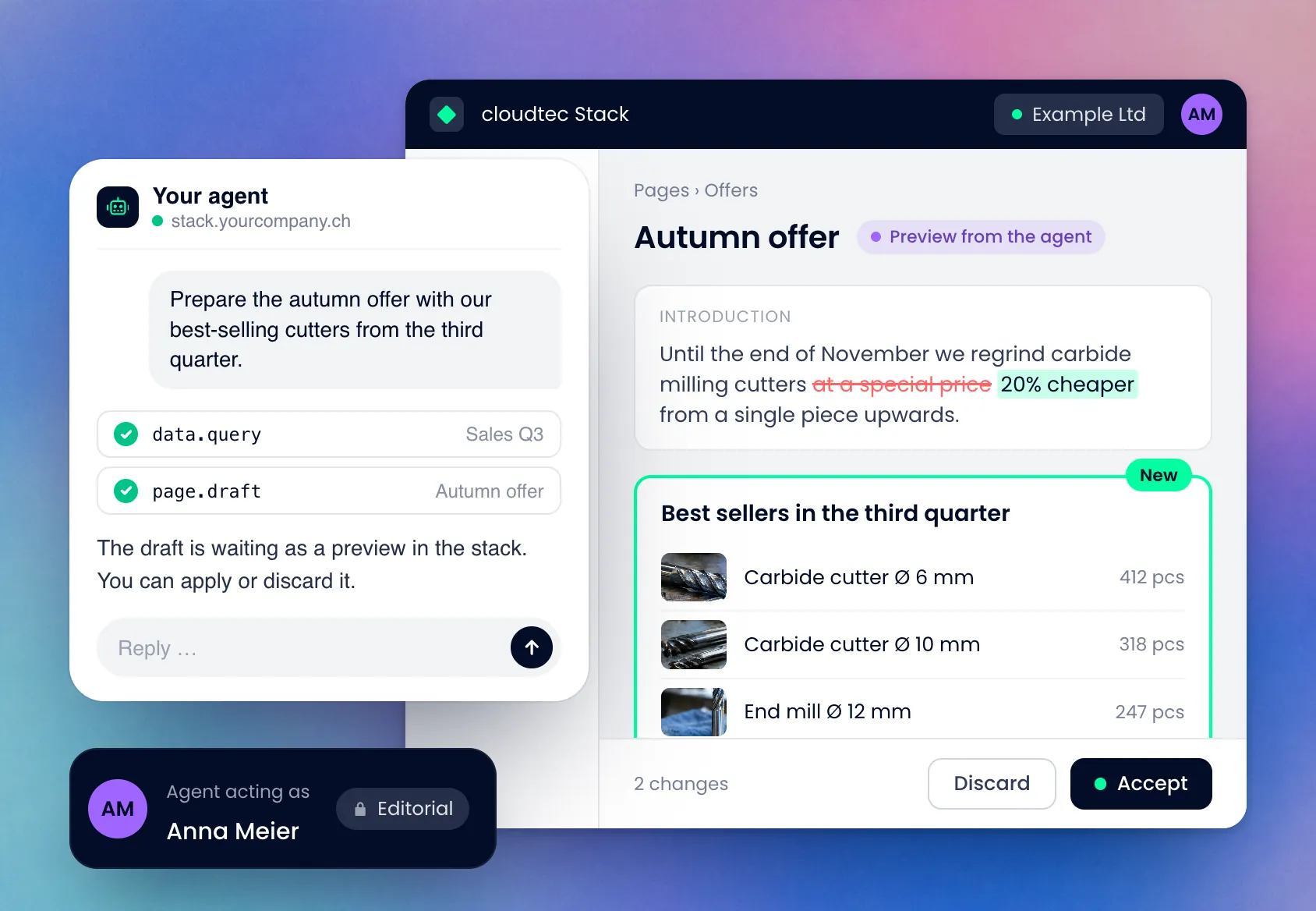
We also develop agents that work directly in the platform. Each one is a separate instance with a clearly defined task. We decide which functions it uses in which processes.
An agent regularly carries out a clearly defined task, for example a report based on the platform’s data. Structure and content are predefined. The platform supplies the figures and facts; the agent adds only what needs interpretation: a summary or an assessment.
It uses external sources only once we have checked and approved them. A guard monitors the network traffic between source and agent. An independent logging instance records every reasoning step and every action. This means you can trace at any time where a statement comes from.
We choose the language model behind it with you based on the task, your business requirements and data protection, because the largest is not always the most economical. Which functions the agent uses does not depend on it.
The features start where editorial teams lose time: shortening, translating, tagging and linking. They all share the same glossary, the same tone of voice and the same data, configured per tenant.
Better texts without switching tools: the Writing Assistant shortens, sharpens and translates directly in the editor, in your brand’s tone of voice.
One image, every format: the crops capture the subject, and the original stays untouched.
Your brand sounds the same everywhere: writing style and terminology apply when writing, translating and linking, in every language.
Being found starts with writing: the hints appear where you are working, not in a report afterwards.
Pages that belong together find each other: the AI suggests links based on content, not keywords.
Accessible and findable from the start: alt text and keywords are ready as suggestions when you upload.
Whether it is the website, forms, notifications or the platform’s own interface: the German text is changed, the French version stays as it was, and nobody notices until someone gets in touch.
When the German version changes, the stack shows every language version that needs updating and what has changed. This applies to page content as well as to the platform’s own texts.
The AI pre-fills missing or outdated translations, using your brand’s glossary and tone of voice. All languages stay at the same level, without anyone keeping lists.
Changed in DE 2 days ago: opening hours adjusted, new section ‘Process’. Update FR?
The other AI features each sit at their own field. The assistant knows the content management system as a whole: it answers questions on how to use it, filters and summarises, and reports what is being left undone.
The avatar, the suggestion and the button at the field are three points of contact. What the assistant may do is the same for all three.
The assistant can only carry out what it has been explicitly permitted to do. Every change is preceded by a preview and followed by an undo, and the change log records who triggered the action and that the AI was involved. Publishing remains manual work, without exception.
Not everyone who visits your website is human: AI agents read, quote and recommend websites when they understand their content.
Every website on the cloudtec Stack comes with what agents need to read it, and keeps it up to date automatically with every new piece of content.
This way, AI assistants understand what you offer instead of guessing it from the layout, and can cite your pages as a source.
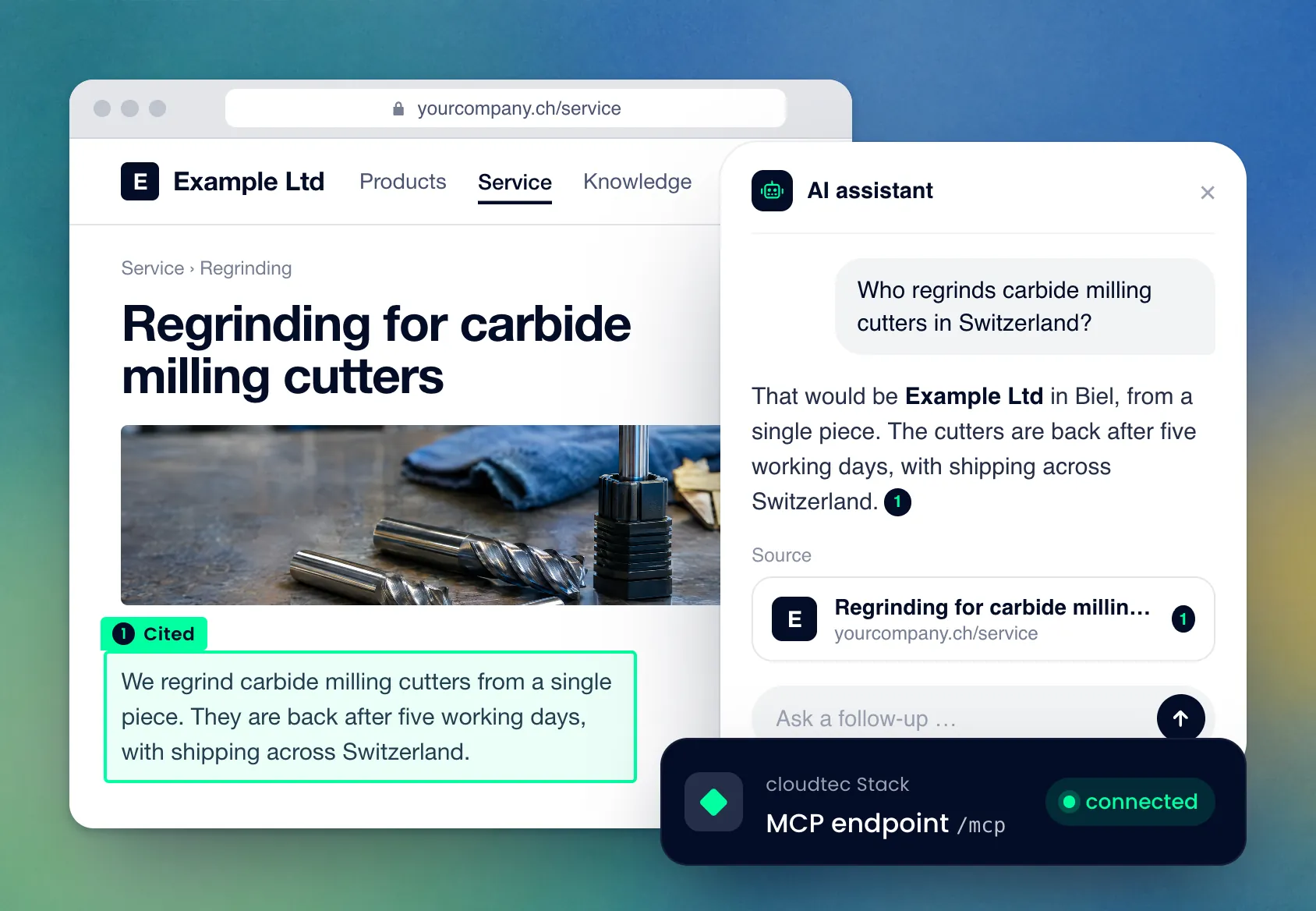
Why we run AI ourselves, how it works in a client platform and how assistants work with your platform via MCP.

The open standard through which AI assistants work with platforms: how MCP works, what the assistant is allowed to do and where we use it in the stack.
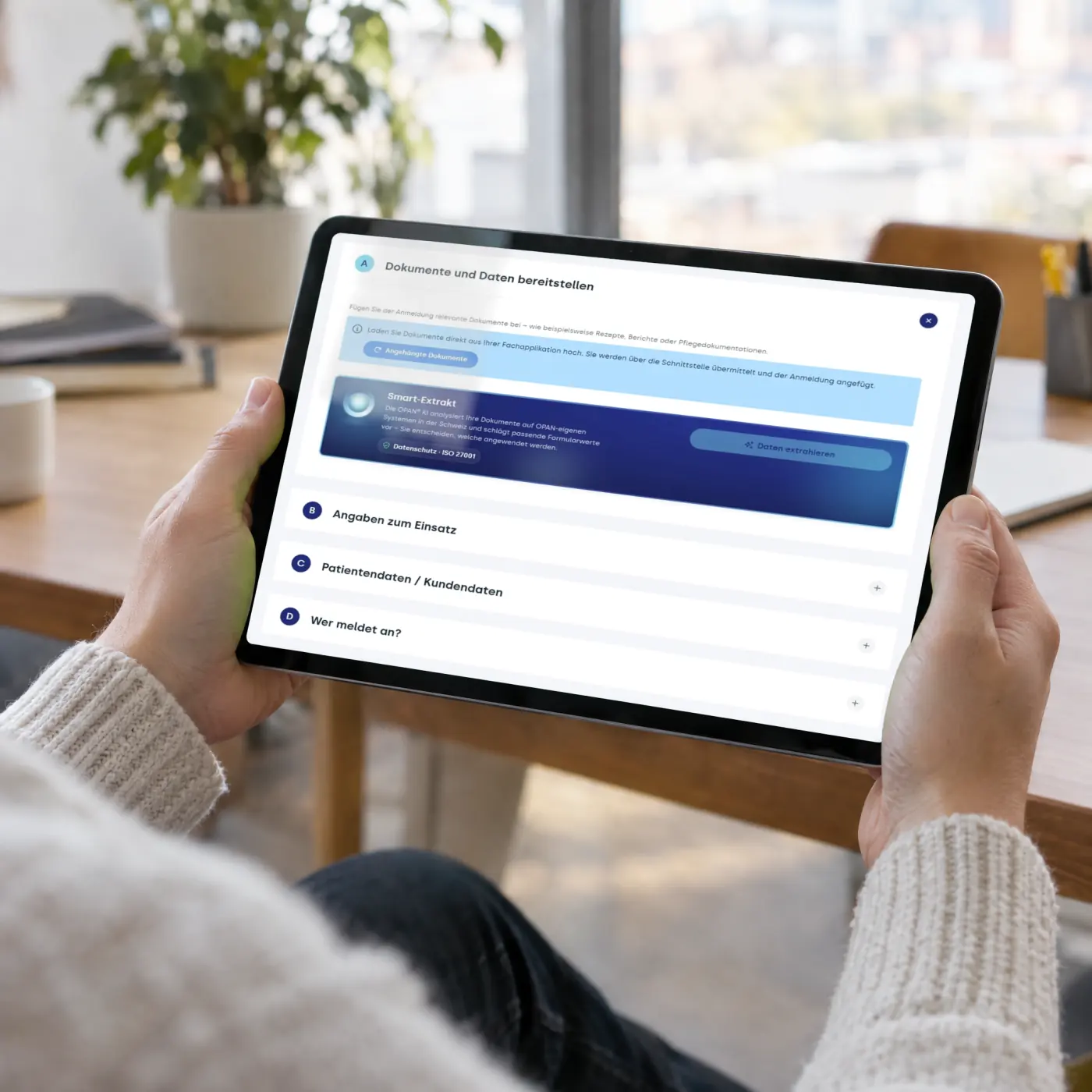
How OPAN® extracts details from documents: pipelines per input format, business logic in schemas and AI on dedicated hardware in Switzerland.
We run AI ourselves instead of just buying it in. Three reasons for the decision and three fields of application we are starting with.
Tell us what is costing you time. Together we check whether AI helps, and build the solution that fits your project, with or without AI.