We are building our own AI expertise
At the beginning of 2025 we decided to run AI ourselves instead of just buying it in: with our own infrastructure, our own expertise and three concrete fields of application that we will build up by the end of 2025.
A large share of our clients work in healthcare, in associations or in sectors with strict requirements. Their data is sensitive and must not leave our network to be processed in someone else’s service. Buying in ready-made AI services would be the quicker route. It just does not fit what we promise for hosting: data in Switzerland, under our control.
Why we run AI ourselves
That is why at the beginning of 2025 we formed a working group and decided to run the models ourselves: open models on our own infrastructure, in the same network as the platforms. At first this takes more time than a contract with a provider. In return, we know for every request where it is processed, and we can swap a model without any client having to change anything.
The second reason is expertise. If you only buy AI in, you do not learn how it behaves, where it fails and what it costs. We want to know that before we recommend it to clients.
Three fields to start with
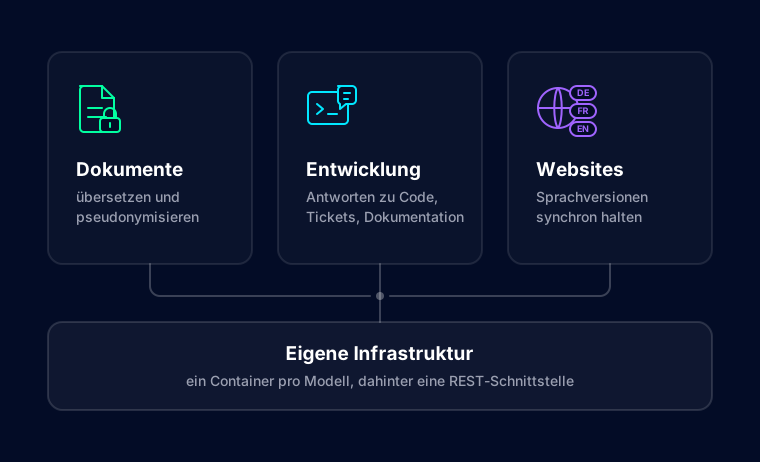
- Documents in healthcare: translating and pseudonymising reports and prescriptions, so that specialists have less to type and personal data stays protected.
- An assistant for development: answering questions about code, tickets and documentation, with answers from our own knowledge instead of from the internet.
- Multilingual websites: keeping content in several languages in sync, using each client’s terminology.
How we build
Each model runs in its own container and can be reached via a REST interface. The applications only know this interface, not the model behind it. When a better model becomes available, we swap the container and nothing else. We anchor the features themselves in the cloudtec Stack, so that they are available to every platform that runs on it.
By the end of 2025 we want to have the infrastructure in place and one feature in use in each of the three fields. We will report on the first results here on the blog.
Postscript: what came of it
We wrote this post before the big surge in coding agents. The plan from back then still holds: the infrastructure is in place, and all AI features now run on our own AI server in the internal network.
With Stack 2.2 we focused mainly on text features. The Writing Assistant in Stack CMS translates, rephrases, shortens and corrects directly in the editor, in the tone and glossary of each tenant. Every result appears as a suggestion, and the editors decide. You can see what this looks like day to day on the page AI in the stack. And in OPAN® the data extraction turns a photographed document into a dossier.
 Written by
Christian Knellwolf
CEO