A stack as the foundation for online platforms and portals
‘Stack’ sounds like jargon but means something tangible: a fixed combination of software components that are matched to one another. How such a stack is structured and what it actually changes for platform projects.
If you don’t deal with IT every day, the term ‘stack’ may not mean much to you. It doesn’t refer to a product category but to an approach: instead of deciding anew in every project which technologies to use, you define a combination of components and build all platforms on it.
What a stack is
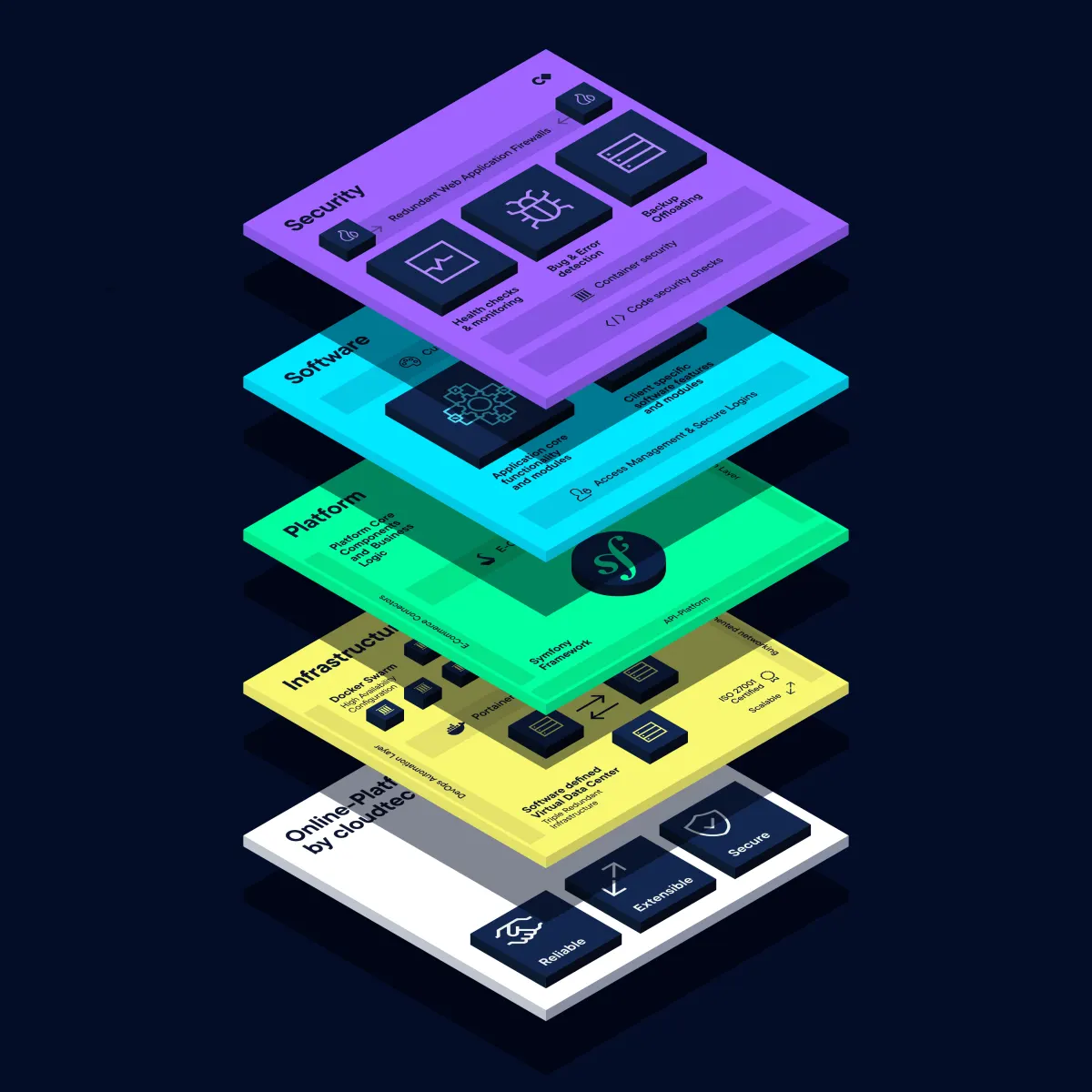
Literally, a ‘stack’ is a pile. What is meant is a set of software components that are matched to one another and complement each other in their functions. Each component covers one area of responsibility, each is a self-contained environment in itself, and they often come from different manufacturers. The modular structure is characteristic: the stack can be read layer by layer and replaced layer by layer.
What a stack consists of
The best-known example, LAMP, shows the composition clearly:
- Linux as the operating system
- Apache as the web server
- MySQL as the database
- PHP as the programming language
That brings together everything needed to put a web application online. In practice, further building blocks are added:
- Programming languages and frameworks
- Databases and search indexes
- Front-end tools
- Back-end tools
- Container and deployment tools
- Applications connected via APIs
Front end, back end and the question of specialisation
The development of platforms, software and websites is divided into two areas. In a CMS, the front end is the visible interface and the back end is the administrative area where you enter and maintain content. The front end is about design, interaction and findability; the back end is about the data model, integrations and architecture.
For both areas, several routes lead to the same result. Besides LAMP there is, for example, WIMP, with Windows as the operating system and IIS as the web server. Anyone who serves both works with twice as many systems, languages and quirks. That is why we commit to one stack that the whole team specialises in. Anyone who masters all of its layers works in full-stack development.
This has tangible consequences. Knowledge can be passed on internally because everyone works with the same tools. Projects remain compatible with one another. And no project depends on a single person who is the only one to know a particular technology.
What a stack is used for
A customer portal needs more than an application: an operating system, a web server, a container layer, a programming language, an application framework and a database. The stack provides this foundation ready-made: matched, tested and proven in operation. This removes a considerable part of the technical risk before the first line of business logic has been written.
At the same time, the stack defines the basis on which extensions are built and how the components exchange data. It is precisely this alignment that later determines speed and stability.
Why our stack relies on open source
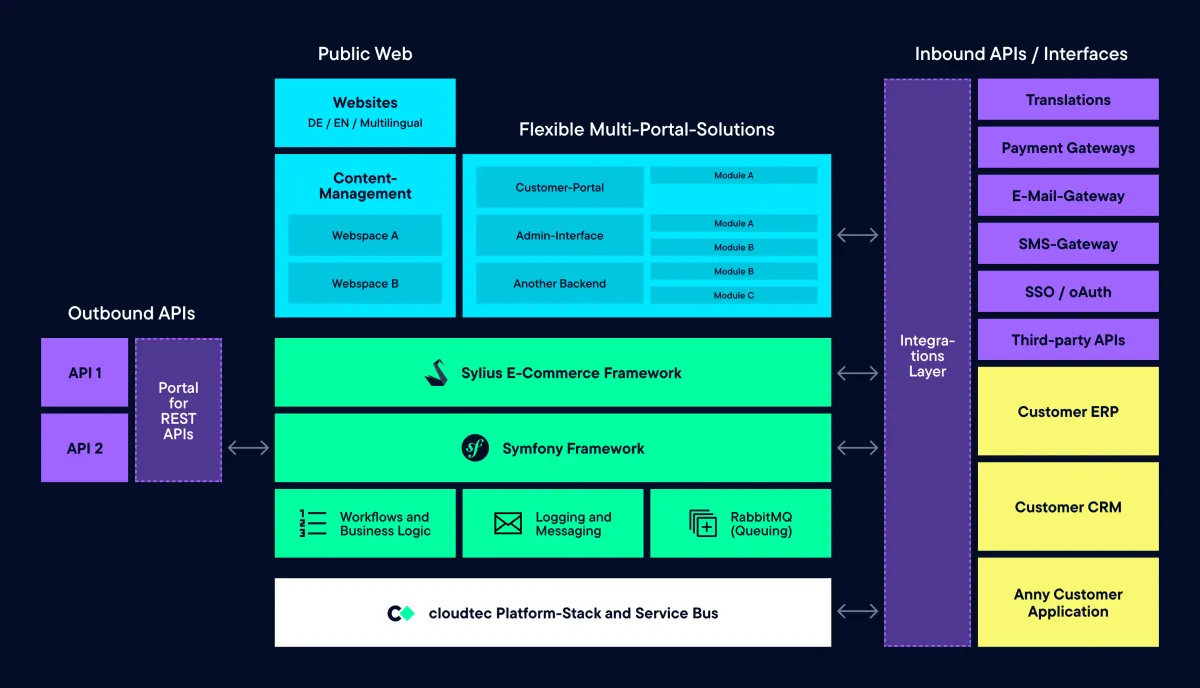
We rely on established open-source components: Symfony as the application framework, API Platform for interfaces, Sylius for e-commerce, MariaDB and Apache Solr for data and search. This keeps the stack designed for long-term operation and still flexible: individual components can be replaced without touching the whole platform.
Beneath it lies the infrastructure. We run the platforms in Docker containers, orchestrated with Docker Swarm and managed via Portainer, on our own infrastructure in the Swiss VDC. The operating system and PHP version are encapsulated per container and defined in the image. Changing infrastructure thus remains a manageable operation rather than a migration project.
Because the stack is continuous from the infrastructure through the platform to the software, installation and deployment are largely standardised. This reduces complexity in operations and simplifies administration.
Standardisation also pays off for security: tests run routinely across all platforms, and a vulnerability is closed once, centrally, instead of in each project separately.
The advantages at a glance
- Clearly defined technology instead of case-by-case decisions
- Standardisation that reduces effort and sources of error
- Knowledge transfer within the team, because everyone knows the same tools
- Compatibility between projects
- Less dependence on individual people
- Standardised deployment and operations according to fixed rules
- Speed through components that are matched to one another
What this means for your project
User management, roles and permissions, API layer, CMS, hosting, monitoring: these requirements recur in almost every platform project. With us, they come from the stack, around 60 per cent of the finished platform. The remaining 40 per cent is what makes your business yours: business model, processes, interface. The overview of the cloudtec Stack shows how the stack is structured in detail.
 Written by
Kevin Jüni
CTO / Senior Fullstack Software Developer