AI in our everyday development work
At cloudtec, AI doesn’t simply write the code. It takes on what used to be left undone: documentation, summaries, first drafts. Three places where it saves time every day, and what people still decide.
AI assistants have helped us write code since 2023, and since 2025 an AI agent has been as much a part of the toolkit as the IDE. It doesn’t sit where architecture is decided. It sits in the places that used to get short shrift because they came after the actual ticket.
Documentation that stays up to date
Technical documentation is now created from a project’s code, tickets and Confluence pages: the AI writes the draft, the developer edits it. The same applies to research across several projects, for example when we want to know how an interface has been implemented in four platforms. The difference from before is not that the documentation is better. The difference is that it exists.
Reviews with assistance
The AI reads along during code reviews. It flags places that deviate from our conventions, missing tests or unclear naming before a colleague opens the pull request. For security tests, we have it run known attack patterns against staging environments and pre-sort the findings. Whether a finding is relevant and whether a pull request is merged is still decided by a person. The AI shortens the path there; it doesn’t replace it.
Prototypes in hours
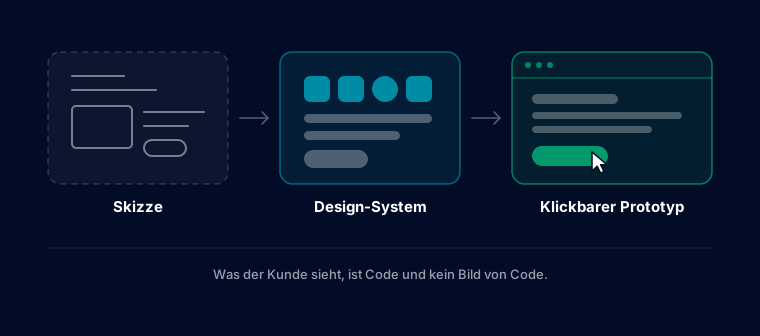
For proposals, we build clickable prototypes instead of slides. Within hours, a sketch and our design system become a working interface in the browser. What the client sees is code, not a picture of code, and it can be reused if the proposal becomes a project. Conversely, design decisions are now often made directly in code, with the design system as a shared language between design and development.
What doesn’t happen
Where client data is involved, the AI runs on our own infrastructure, not on a public service. And no change goes into production without being reviewed by a person, no matter who wrote the proposal. The AI in the stack page shows what the AI features in our platforms look like.
 Written by
Urs Imhof
CXO / Senior UX Designer & Researcher