Platform development with Reverse and Forward Engineering
A new build, a replacement or both at once: the starting point decides which approach a platform is built with. What distinguishes Reverse from Forward Engineering, and how we combine them in our projects.
In platform development, there are three typical starting points. The greenfield project, which can be conceived from scratch. The replacement of existing software on a new technological basis. And the hybrid: a replacement that incorporates improvements at the same time. Depending on where a project starts, different engineering approaches come into play.
What is Reverse Engineering?
In Reverse Engineering, you analyse an existing system with the aim of understanding it: its design, structure and behaviour. Depending on the starting point, this involves code analysis, disassemblers or decompilers, but more often simply tracing the data model, interfaces and operating logic.
The result varies:
- documentation of the existing system: a UML diagram, a flowchart or a specification;
- a newly built system on a new technology that meets the same requirements as the old one.
The approach also works for intermediate steps: tracking down errors, assessing the quality of existing software, evaluating compatibility with other systems.
What is Forward Engineering?
In Forward Engineering, software is created from scratch. The system is designed and implemented on the basis of requirements and specifications. Before that, these requirements must be detailed, relationships and complexities made visible and special cases defined. At its core, it is about translating business processes, services and functions into an application. No existing code is analysed; new code is written.
On a greenfield site, ideas can be tested quickly as a prototype. On the other hand, it usually takes longer until the actual requirements and constraints are settled. With Reverse Engineering, the legacy system supplies them.
How we approach projects
Both approaches are part of our everyday work, often in the same project. Where we use Reverse Engineering, we build in improvements and extensions in the same step so that technical debt does not move across with the system. On top of that come workshops: we get to know our clients’ processes in detail and decide together where digitalisation really makes a difference.
Swiss Hiking Trail Federation
Both approaches came into play in the 2023 relaunch of the website and platform. We analysed the old CMS and the entry of hikes and rebuilt how they work in the new system. Content entry, by contrast, we did not carry over but replaced with a new way of working and expanded it. Other parts (the assignment of tags to content pages, media management) were built from scratch without prior analysis. The details are in the success story about the platform for everything hiking.
OPAN CARE
The e-health platform of OPAN CARE AG needed a technological update: a new technical basis, plus new functions and modules in the range of services. The demanding part was the Reverse Engineering of the existing components: the system is in productive use, and numerous interface integrations depend on it. To keep the transition seamless, we built a legacy connector. It maps the old API calls to the new API and gives the integration partners time to migrate their systems. For users, this means no loss of functionality.
Sanitized
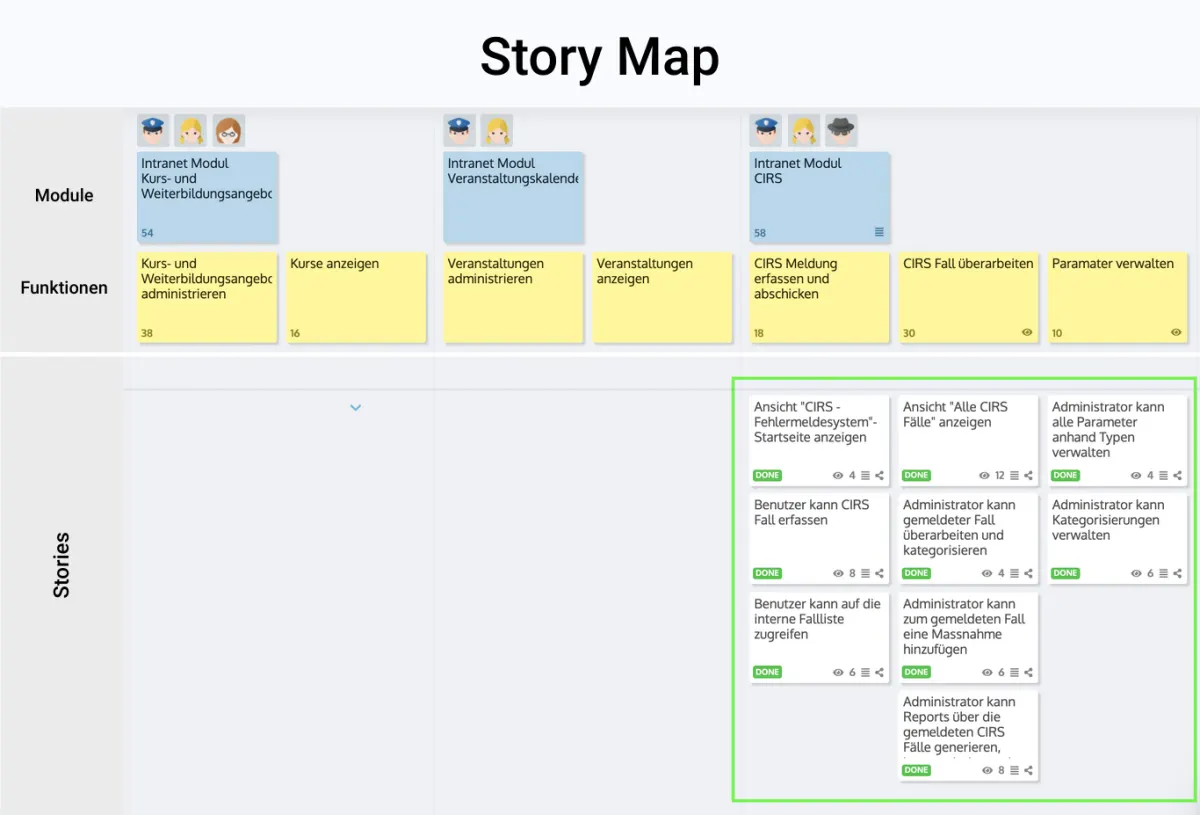
At Sanitized, we were able to build a system from scratch and rethink the processes. First, the business processes were analysed and critically questioned. The requirements became a story map, the story map became prototypes and, finally, the platform with all its business rules. The project is in our list of case studies.
Rotary
The association platform for Rotary in Switzerland, France, Belgium and Luxembourg made it possible to combine both approaches. The association software from 2012 was completely replaced through Reverse Engineering; the analysis of the existing functions made it possible to derive the many small business rules. We built on a modular basis that can be extended step by step and operated over the long term.
Which approach suits your project?
That depends less on the technology than on how much knowledge is contained in the legacy system and how much of it is to be preserved. In most projects, it is a mixture of both anyway. Describe your project to us and we will take a look.
 Written by
Urs Imhof
CXO / Senior UX Designer & Researcher