Three project phases to a successful online platform
From the first workshop to ongoing operations: we divide platform projects into three phases. What happens in each of them and what you see from us.
An online platform replaces workflows that currently run through emails, Excel files and paper. It keeps the data in one place and brings the people involved together: staff, customers, partners, members. That is a big undertaking. This is why we divide it into three phases: concept, implementation, operations.
What an online platform is
An online platform is a web-based application through which different user groups work together. It maps processes, keeps the associated data in one place and provides both in the form each group needs: in the browser, on a mobile phone or through an interface in a third-party system. Depending on the starting point, the focus is on exchange, on handling a business process or on selling products and services.
Phase 1: the concept
The concept phase decides what gets built and what does not. It runs in three steps:
- Clarifying needs and goals. What problem should the platform solve, who works with it, how does it work today? We look at your existing workflows before we talk about functions.
- Recording the concept and requirements. Functions, roles, data model, interfaces and security requirements are described and prioritised.
- Showing mockups, gathering feedback. Before any code is written, mockups make the solution visible. A change here costs minutes instead of sprints.
Depending on scope and way of working, this means three to four workshops in which requirements and mockups take shape iteratively. The result is a concept that forms the basis for planning, effort and implementation.
Phase 2: implementation
Development follows Scrum. At regular intervals we show you what has been added. Misunderstandings are spotted early this way, and priorities can be shifted while that is still cheap. Whether you go to market early with a minimum viable product or first accept the complete solution is your decision.
We use these Scrum elements:
- Product backlog: all requirements formulated as user stories, prioritised together with you and continuously added to.
- Sprint planning: the team selects the stories for the next sprint and breaks them down into tasks.
- Daily Scrum: a few minutes every day in the development team, across all projects, not per project.
- Sprint: stages lasting several weeks, each ending with working functions.
- Review and retrospective: showing the result, examining the way of working. At cloudtec, both take place company-wide across all projects.
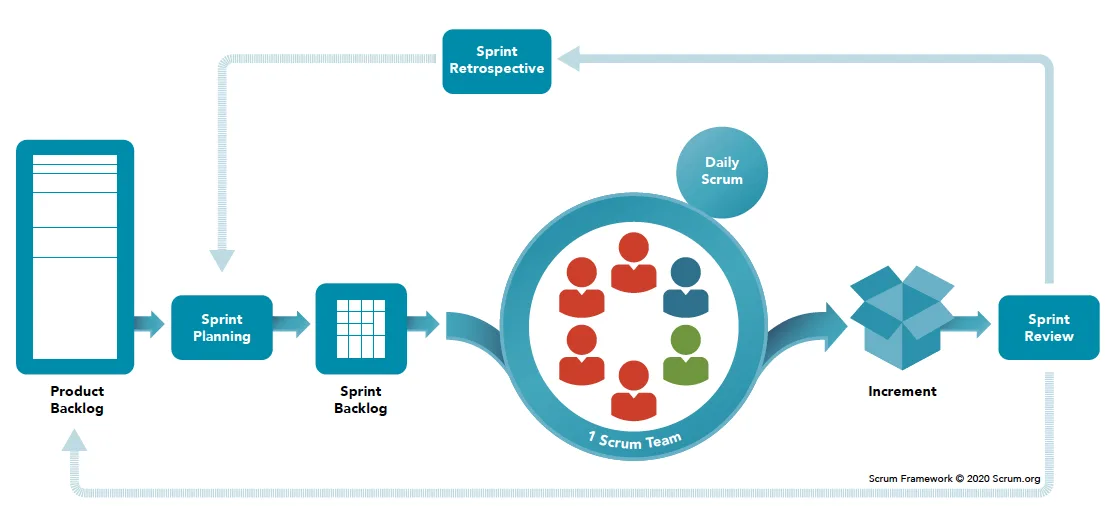
Implementation extends over several sprints, with the backlog updated along the way. Once the MVP or the complete platform is on the test system, acceptance begins: test, adjust, test again. When all parts have been accepted, the go-live follows.
How we work in an agile way is described in more detail in our two posts on agile software development: part 1 and part 2.
Phase 3: operations
After go-live, the platform is in production, and our work continues. We keep the framework, dependencies and infrastructure up to date, monitor operations and plan new functions with you. This way the platform grows with your business instead of having to be replaced after a few years.
Dividing the work into three phases is not an end in itself. It keeps the expensive decisions where they are still cheap (in the concept) and makes progress in implementation visible sprint by sprint.
 Written by
Trevor Timmers
COO / Senior Project Manager